Funding Readiness/9 min read
Is your business ready for UA funding? A founder's eligibility checklist
Review your product, team, cash flow, acquisition metrics and payback before a funding conversation. A preparation guide, not an approval score.
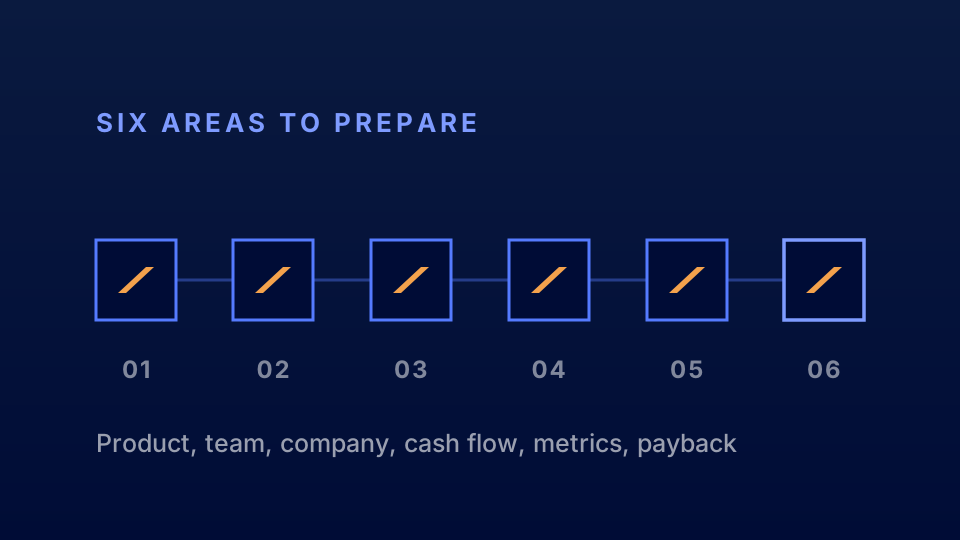
Your business may be ready for user acquisition funding if it has a good product, a capable team, and measurable acquisition performance that supports a credible path to payback. The company also needs enough financial capacity to manage growth while those returns arrive.
UA funding can be relevant to apps and B2C or B2B2C companies with a measurable acquisition model.
At Lynx, we assess the whole business. Strong metrics may support a relatively young company's case. A smaller acquisition budget may still be worth funding. No single number tells us everything.
This checklist combines Lynx's approach with practical questions founders should address before a funding conversation. It is a preparation guide, not an approval score.
How Lynx assesses funding readiness
Lynx looks for active acquisition campaigns and a performance history showing stable returns and credible payback. We consider that evidence alongside the product, team and company's financial circumstances.
We prefer monthly acquisition spend above $100K, but this is not a firm cutoff. Smaller businesses can be considered when the overall case is compelling. We consider companies worldwide, with six months of operating history as our usual starting point for discussion.
Criteria are flexible, but the underlying evidence still matters. A promising business needs to show why additional acquisition spending makes sense.
1. A product with demonstrated customer value
Acquisition funding works best when there is evidence that the product delivers value after the initial purchase, installation or signup.
That evidence depends on the business model. It might include engagement and purchases in a game, subscription renewals in a consumer app, or repeat transactions in a service business.
For a B2B2C company, explain the relationship between your business customers, distribution partners and end users. Who do you acquire, who pays, and how does that activity generate revenue?
- What the product does and who uses it.
- How the business earns revenue.
- What shows that customers stay, renew or purchase again.
- Whether planned product changes could affect historical performance.
A good product story should be supported by customer behavior, not only market potential.
2. A team that can manage growth
More capital creates more responsibility. Someone needs to manage acquisition spending, monitor product performance and understand the financial consequences.
You do not need a large team. You need clear ownership of those responsibilities.
- Make spending decisions.
- Track customer retention and revenue.
- Monitor cash flow and repayments.
- Respond when performance falls below expectations.
If you rely on agencies or external partners, explain their role and how your company oversees their work.
3. A clear company and financing picture
Prepare a concise overview of the legal entity, ownership, operating history and existing financial commitments.
Whether you are bootstrapped, angel-backed or VC-backed is useful context. Investor backing does not replace a good product or reliable acquisition economics.
Review existing loans, credit facilities and investor agreements. Check whether a new facility could require consent or conflict with another lender's rights.
Distinguish cash already available from a planned investment round. Expected funding can be part of a forecast, but it is not the same as money in the bank.
4. Cash flow that supports operations
A business can have attractive acquisition returns and still struggle to cover operating expenses.
Revenue may arrive gradually while payroll, development, support and other bills continue. Your cash-flow plan needs to account for that timing.
- Cash currently available.
- Regular operating expenses and existing obligations.
- Your contribution to the acquisition budget.
- Expected revenue receipts.
- Cash retained after proposed funding repayments.
Then test a slower-payback scenario. Could the company continue operating if acquisition returns arrive later than expected?
There is no universal runway requirement in this checklist. The aim is to understand whether the proposed funding fits your financial circumstances, rather than assuming campaign performance will solve every cash shortfall.
5. Acquisition metrics that hold up over time
A successful campaign is encouraging. Repeated performance provides a stronger basis for funding.
A cohort is a group of customers or users acquired during a defined period or through a particular campaign. Comparing cohorts helps show whether acquisition results are consistent.
Useful metrics may include customer acquisition cost, retention, repeat purchases, lifetime value and return on ad spend. Their relevance depends on your business model.
- Are returns reasonably stable across cohorts?
- What happens as spending increases?
- Does performance depend heavily on one channel or partner?
- Can you connect acquisition spend to customer revenue?
Compare cohorts at the same age, and separate observed results from forecasts.
At Lynx, positive-looking acquisition performance is central to the assessment. Flexibility means considering the evidence in context, not overlooking weak economics.
6. A credible path to payback
Payback is the time needed to recover acquisition spending from the revenue or contribution generated by acquired customers, depending on how the measure is defined.
Explain your calculation clearly. Gross revenue, net revenue and contribution after relevant costs are not interchangeable.
- What customers have already generated.
- What future returns depend on.
- Why retention or purchasing behavior supports those assumptions.
- How slower returns would affect company cash.
Lynx does not apply one payback benchmark to every business. We assess the expected period alongside performance stability and the broader company picture.
7. A specific plan for the capital
"Grow faster" is not enough to explain a funding request.
Identify which acquisition activities the funding would support, why they are suitable and how you would monitor the results.
Your plan should connect the requested capital to a defined budget, supporting performance data and decisions you would make if returns weaken.
Do not assume that a larger budget will produce the same efficiency. Explain what the next spending increase would test and when you would reconsider it.
Your funding-readiness checklist
Before speaking with Lynx, check whether you can clearly explain:
- Your product, customers and revenue model.
- The team responsible for growth and finance.
- Company ownership, investors and existing obligations.
- Cash available for operations.
- Repeatable acquisition performance.
- Expected payback and its assumptions.
- The intended use of funding.
These are preparation questions, not seven separate approval conditions. Gaps should be discussed openly so the full business can be assessed.
Frequently asked questions
Is Lynx funding only for mobile games?
No. Mobile games are a primary focus, but Lynx can also consider other apps and B2C or B2B2C businesses with a good product, capable team and measurable acquisition economics.
Do I need VC backing?
VC backing is not a substitute for funding readiness. Your investors and existing financing provide context, while the product, acquisition performance and financial position still need assessment.
Can a company spending below $100K per month be considered?
Yes. Lynx prefers acquisition spend above $100K per month, but smaller businesses can be considered case by case.
Does meeting the checklist guarantee approval?
No. Lynx weighs the company's strengths, weaknesses and performance evidence together. Final eligibility and terms depend on underwriting.
Bring the whole business into the conversation
Prepare your acquisition data alongside a clear picture of the product, team and company finances. Show what has already worked, what you want to fund and where uncertainty remains.