Pricing/7 min read
How is the fee calculated for UA funding?
Pricing models, outstanding balances and cohort repayment, and how the three figures in a funding quote fit together.
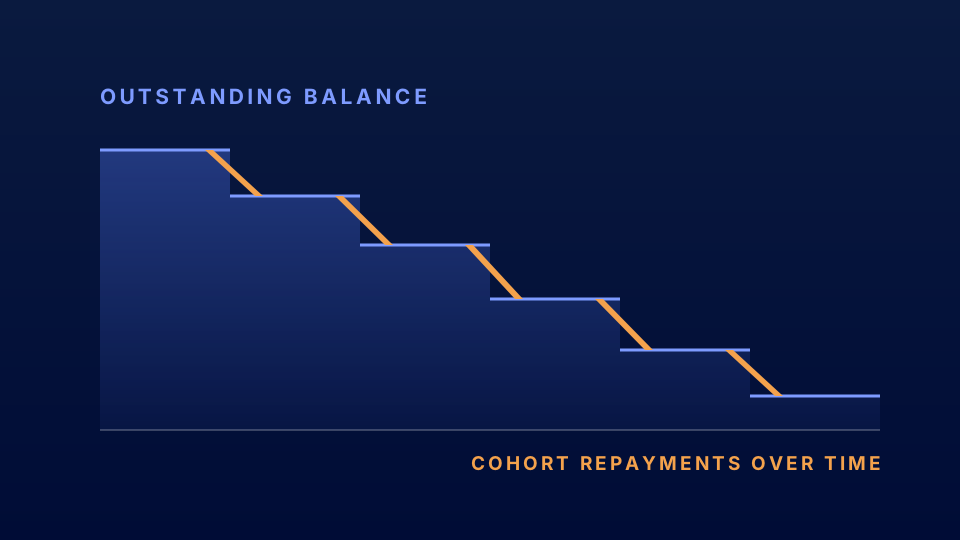
The fee for user acquisition funding depends on the pricing model and the terms agreed during underwriting. In Lynx Capital's most common model, a monthly fee accrues on the outstanding balance. As funded cohorts generate revenue and repay that balance, the amount used to calculate subsequent fees changes.
To understand the total cost, founders need to know what the fee applies to, how repayments reduce the balance and how long the funding remains outstanding.
This applies to mobile games, other apps and B2C or B2B2C businesses with measurable acquisition performance.
Start with the pricing model
UA funding does not have one universal fee structure.
A flat-fee model and a monthly-fee model can produce different costs, even when their headline percentages look similar.
Lynx works with several pricing models. The most common is a monthly model based on the outstanding balance, with repayment linked to the performance of the funded cohorts.
In this model, the cost develops as the balance is repaid. Understanding that relationship is the starting point for evaluating an offer.
What does "outstanding balance" mean?
The outstanding balance is the amount that remains unpaid under the agreement.
In a balance-based monthly model, the fee is calculated on that remaining amount rather than treating all the original funding as outstanding throughout the repayment period.
As cohorts repay the facility, the balance generally falls. A smaller balance provides a smaller basis for subsequent fee calculations, assuming the same rate and calculation method.
The timing matters too. When repayments are credited, how they are allocated and whether unpaid fees enter the balance can all affect the calculation. Additional funding drawdowns may also increase the amount outstanding.
How does Lynx determine the fee rate?
Lynx sets the rate through underwriting. We consider acquisition performance alongside the company behind it.
Factors include:
- The quality and consistency of the cohorts.
- The company's financial and operating position.
- The volume of financing.
- The investors involved in the business.
- The company's growth rate.
Larger financing volumes can support a lower fee rate, but size is considered alongside the other factors.
A strong cohort history helps explain expected returns. Company finances and investor context help explain the business's capacity to support its growth plan.
Lynx's pricing depends on that individual assessment and the agreed structure, rather than a single public rate.
How does cohort repayment affect the total fee?
A cohort is a group of customers or users acquired during a defined period or campaign. In cohort-based funding, their performance informs repayment.
Under a monthly outstanding-balance model, repayment speed affects how much remains unpaid and for how long.
If cohorts repay faster, the balance falls sooner. That generally reduces the amount on which future fees accrue. If repayment is slower, a balance may remain outstanding for longer, allowing additional fees to accrue under the agreed terms.
A useful repayment projection should show:
- The expected outstanding balance over time.
- Fees expected to accrue.
- Repayments expected from funded cohorts.
- The total projected amount collected.
- How those figures change if returns arrive more slowly.
This makes the cost easier to assess against the performance you expect from the funded acquisition activity.
Revenue share and the fee are different things
The share of cohort revenue used for repayment is not necessarily the fee rate.
Revenue collected from a funded cohort can repay the funding and cover fees. A repayment percentage describes how revenue is collected, not the financing cost by itself.
Keep three figures separate when reviewing an offer:
- The amount of capital deployed.
- The fee charged for that capital.
- The share of revenue applied to repayment.
That distinction helps you understand both what the funding costs and how it will be repaid.
Consider the effect on company cash flow
The total fee matters, but so does the cash available while the facility is being repaid.
Revenue applied to repayment is not available for payroll, product development or other operating expenses. Review the proposed structure alongside the company's operating cash-flow forecast.
Check whether the business can cover its obligations under both the expected repayment scenario and a slower-performance scenario. Funding should be assessed in the context of the whole business, not only the acquisition campaign.
What to confirm before accepting an offer
Lynx does not charge hidden fees or early-repayment penalties. Repayment follows the funded cohorts' repayment rate, subject to the contract.
Before signing any funding agreement, confirm:
- The pricing model and balance used to calculate fees.
- When fees accrue and repayments are credited.
- How payments are allocated between fees and funded capital.
- Every applicable charge.
- Any repayment caps, deadlines or conditions.
- What happens if cohort returns fall below expectations.
The contract governs these details. A repayment projection helps you understand their expected financial effect, but it is not a guaranteed outcome.
Have a funding quote? Understand what it will cost.
An offer is easier to evaluate when you can see the total projected fees, repayment timeline and cash the business retains.
Send us a funding quote you've received. We'll break down its total cost and cash-flow impact for you.