Growth/8 min read
How UA funding can help your business grow
Keep acquiring while returns arrive, without issuing new equity. What the funding enables, what it costs, and when a business is ready for it.
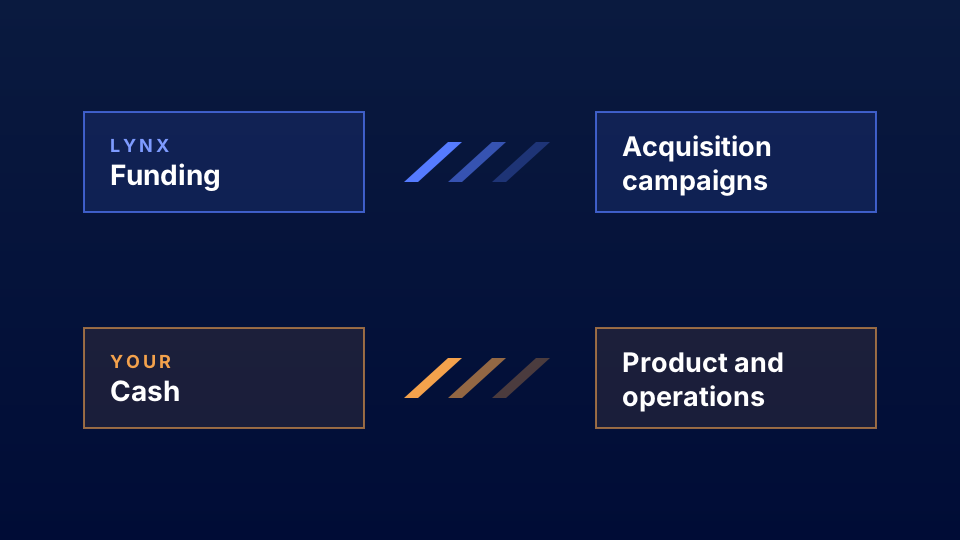
A growing company can have a good product, strong customer cohorts and acquisition campaigns that generate solid returns, yet still lack the cash to keep expanding at the pace its performance supports.
User acquisition funding can help close that gap. It provides capital for acquisition without requiring founders to issue new equity, while allowing more internal cash to remain available for product development and operations.
The same need can arise in apps and B2C or B2B2C businesses with measurable acquisition economics.
The benefit depends on what the funding enables, how much it costs and whether the company can support the growth.
Keep growing while acquisition returns arrive
Customer acquisition spending and customer revenue rarely arrive at the same time.
A business pays for campaigns before it collects all the revenue those customers are expected to generate. Even when acquisition works, waiting for that revenue can limit the next round of spending.
UA funding can provide capital during that interval, helping a company continue investing in campaigns with demonstrated performance.
This is most relevant when the acquisition model is already working and available cash is constraining growth. Additional funding does not make weak campaigns profitable.
A quick check: is your acquisition model ready for funding?
Before considering UA funding, check whether your data supports the following:
- Customer value exceeds acquisition cost. Your measured or credibly forecast customer lifetime value should exceed customer acquisition cost. Be clear about whether the calculation includes relevant delivery costs, platform fees and refunds.
- Payback is measurable. You can show when acquisition spending is expected to be recovered, separating observed returns from forecast revenue.
- Performance is repeatable. Successive cohorts show a reasonably stable revenue or ROAS pattern, rather than relying on one exceptional campaign.
- Operating cash supports the repayment period. The company can cover its operating needs for longer than the expected cohort payback period, accounting for fees and repayment commitments.
- The data can be checked. Acquisition spend, customer revenue and retention or repeat-purchase reporting are accessible and consistent.
These are readiness indicators, not fixed approval thresholds. Lynx assesses cohort performance alongside the product, team and company finances. No single metric guarantees eligibility.
Support growth without issuing new equity
Raising equity can fund product development, hiring and other strategic needs. But founders may not want to sell another ownership stake simply to finance acquisition activity with measurable returns.
Non-dilutive UA funding offers a different route. It can support acquisition without issuing new shares, allowing founders to retain more ownership as the business grows.
It may also reduce the amount of equity capital a company needs to raise for its acquisition plans. That does not eliminate the need for sufficient company capital. It gives founders another way to allocate it.
The choice should reflect what the business is financing, rather than treating equity and UA funding as interchangeable.
Preserve internal cash for the product and operations
Using all available cash for marketing can leave less room for development, customer support and day-to-day operations.
External acquisition funding can help a business allocate more of its own resources to those activities while continuing to acquire customers.
That matters because growth depends on the product as well as the campaigns. New customers need a product that delivers value, and the team needs the capacity to support them.
However, preserving cash is not the same as removing a financial obligation. The company must account for funding repayments and fees when planning what remains available for operations.
Draw capital according to the growth plan
A company's acquisition needs can change as campaigns perform, products develop and new opportunities emerge.
The ability to draw only the funding needed can help founders match capital deployment to their plans, rather than committing the full facility at once.
At Lynx, drawdown flexibility is part of the funding discussion. The agreed facility determines how capital can be accessed.
Founders should connect each drawdown to a clear use: which acquisition activity it supports, what evidence justifies the spend and how performance will be monitored.
Evaluate the fee against the growth it supports
The fee matters, but it should be considered alongside the business value of the funding.
For a fast-growing company, the decision may include the value of continuing acquisition, preserving ownership and receiving ongoing support, rather than choosing on the fee alone.
The useful question is whether the expected benefit of funded growth justifies the financing cost and repayment commitments.
That assessment needs realistic assumptions. Increasing spend may change acquisition efficiency, and expected customer revenue may arrive more slowly than forecast.
A good funding decision considers those possibilities before capital is deployed.
Keep operating cash ahead of cohort payback
UA funding works alongside the company's wider financial resources.
The business needs sufficient cash to cover operations for longer than the time its cohorts are expected to take to generate returns. Otherwise, attractive acquisition economics can coexist with an operating cash shortage.
Lynx monitors that position monthly as part of the funding relationship. Founders need to understand:
- Cash available for operating expenses.
- Expected cohort returns and their timing.
- Funding repayments and fees.
- Existing financial commitments.
- The effect of slower-than-expected payback.
This ongoing view helps connect acquisition growth with the company's ability to sustain it.
Plan financing, marketing and product together
A funding plan should be part of the company's growth strategy, not a separate exercise.
Marketing determines how customers are acquired. The product influences whether they stay and generate revenue. Financing determines how the company supports the spending and manages the interval before returns arrive.
Before using UA funding, make sure those plans support one another.
Stable campaigns and reliable data are important, but so are a healthy product, a capable team and enough operating capital. If those foundations need work, increasing acquisition spending may not be the right next step.
See how funding could support your next stage of growth
UA funding can help a business continue acquiring customers without relying entirely on internal cash or another equity round.
Its value is strongest when the company has demonstrated acquisition returns, a product worth scaling and a financial plan that supports the repayment period.
Apply for UA funding to support your next stage of growth without giving up equity.
Share your business details and acquisition performance so Lynx can assess the funding structure that fits your growth plan.